
Ask any successful fashion designer one question—“What’s the most important skill after designing?”
Most of them will have the same answer: Stitching.
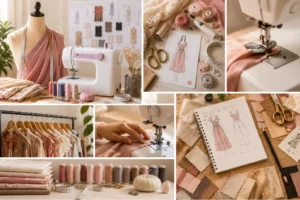
If you’ve been following my work for a while, you probably know that I’m a huge believer in fashion illustration. Whether it’s traditional hand sketches, digital illustrations, or even AI-powered fashion design, illustration is an essential skill for every designer. It’s how we communicate ideas, present collections, and visualize our creativity.
But over the years, after teaching thousands of fashion students and interacting with aspiring designers across India, I’ve realized something.
Most students know how to draw a garment, but very few know how that garment is actually made.
And that’s a problem.
Today, there are countless resources available to learn fashion illustration. You can join online courses, watch tutorials, or even learn through AI tools. Fashion colleges also dedicate a significant amount of time to sketching, rendering, and presentation techniques.
That’s great because illustration is an important part of becoming a fashion designer.
However, one skill that often doesn’t receive the same attention is stitching.
In my opinion, this is where many aspiring designers miss an opportunity to become truly industry-ready.
Anyone can create a beautiful sketch.
The real question is:
Can that design actually be stitched?
This is something many students don’t think about while designing. They create interesting silhouettes, dramatic sleeves, unique necklines, and creative drapes, but when it’s time to make the actual garment, they don’t understand how those elements come together.
That’s because designing and garment construction go hand in hand.
When you understand stitching, you automatically begin designing with practicality in mind. You know what will work, what needs modification, and how different construction techniques affect the final garment.
For me, learning stitching isn’t about becoming a tailor.
It’s about becoming a better fashion designer.
Once you understand garment construction, your entire design process changes.
Instead of only thinking about aesthetics, you start thinking about structure, fit, comfort, balance, and finishing. You begin to understand why certain seams are placed in specific areas, how darts shape a garment, how different fabrics behave, and why some silhouettes work better than others.
These are things you simply can’t learn by looking at illustrations alone.
The more you understand construction, the more realistic, functional, and wearable your designs become.
This is just my personal opinion based on my experience.
Most fashion colleges introduce students to a wide range of subjects—fashion illustration, textiles, pattern making, history of fashion, CAD software, and much more.
But when it comes to stitching, many students only get limited practical exposure.
As a result, a lot of graduates still depend entirely on tailors or sampling units to understand how their garments will actually be constructed.
I believe every fashion designer should at least understand the basics of stitching and garment construction. You don’t have to become an expert tailor, but having this knowledge makes you a much stronger designer.
Whenever I work on a fashion illustration, I already imagine how the garment will be stitched.
That understanding helps me make better design decisions from the very beginning.
It also makes communication with tailors, manufacturers, and production teams much easier because I know the language of garment construction.
That’s why I always encourage fashion students to learn stitching alongside illustration.
These two skills complement each other perfectly.
Illustration helps you express your creativity.
Stitching helps you bring that creativity to life.
If you’re looking to build this skill, there are several good resources available today. One course that I recently explored is the Basic to Advanced Stitching Course by Talented Ritu Insan. What stood out to me was its practical curriculum, which starts with sewing machine basics and gradually covers garment construction, kurtis, salwars, blouses, collars, sleeves, frocks, measurements, and professional finishing techniques. It offers a structured learning path for beginners who want to understand how garments are actually made.
Fashion illustration will always be one of the most exciting parts of fashion designing, and I don’t think anyone should stop learning it. But if your goal is to become a complete fashion designer, don’t limit yourself to drawing beautiful garments.
Learn how they’re made.
Because when you understand stitching, you don’t just become someone who designs clothes—you become someone who understands fashion from concept to creation.
And in my opinion, that’s what makes a complete fashion designer.
Check Details :
https://talentedrituinsan.com/course/Blouse-Advance-Course
————————————